The Climate Crisis
Equipping leaders with the data and market insights needed for climate action.
Market-driven. Science-led.

Click to enlarge
Total global greenhouse gas emissions reached a record 60.63 gigatons (CO2e) in 2025—a 2.4% increase over the previous year. This trajectory represents more than just an environmental challenge; it is a fundamental breach of global economic stability.
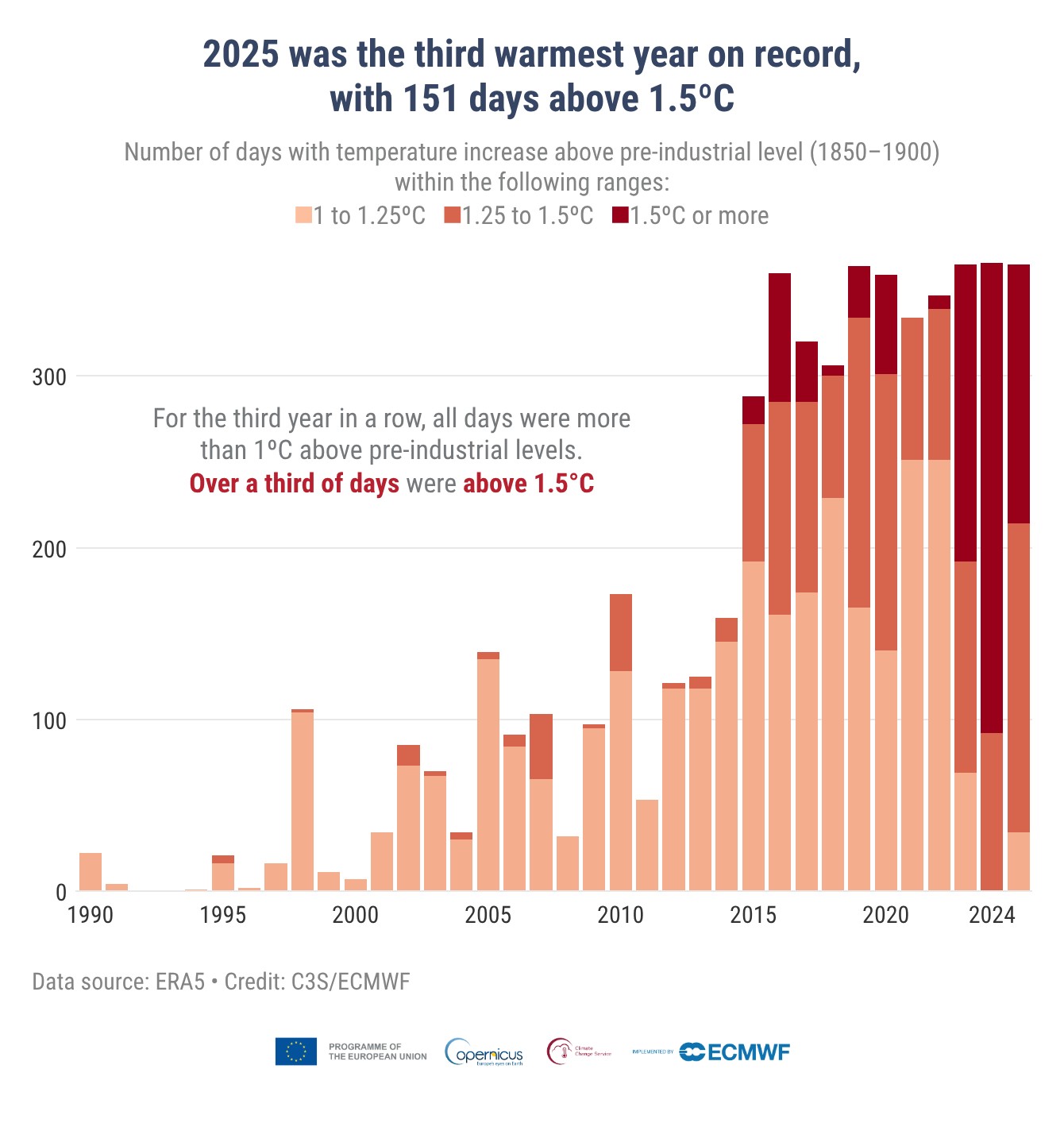
Systemic climate impacts—including disrupted supply chains, compromised water security, and mounting economic liabilities—are manifesting in real-time. In 2024, global temperatures exceeded the 1.5°C pre-industrial average, marking a critical threshold in atmospheric volatility. With the ten warmest years on record all occurring within the last decade, the trend of accelerating warming is undeniable.
This data confirms that the era of theoretical risk has ended. To preserve long-term economic stability and institutional resilience, we must deploy aggressive, market-aligned strategies to synchronize global capital with local action, and to mitigate the primary drivers of this volatility: carbon dioxide (CO2), nitrous oxide (N2O), and methane (CH4).
While Carbon Dioxide (CO2) is the primary driver of long-term warming, Nitrous Oxide (N2O) and Methane (CH4) represent acute, high-potency liabilities that accelerate near-term tipping points. Achieving absolute emissions reduction across all three is the only path to market stabilization.
Fossil CO2 emissions reached a new record of 38.1 Gt in 2025. With more than 90% of emissions generated from burning fossil fuels, atmospheric CO2 has reached a record 427.35 ppm (Mauna Loa Observatory). 2026 is anticipated to reach 429.4 ppm or higher, intensifying the cascading "cost of carry" for an atmosphere where CO2 persists for over 300 years.
Human-made N2O emissions increased by 40% between 1980 and 2020. N2O is 265 times more potent than CO2 and represents a high-intensity liability that persists in the atmosphere for at least 127 years, making sustainable agricultural innovation a mathematical necessity for climate stabilization.
CH4 levels reached 339 ppb in 2025, exceeding pre-industrial benchmarks by over 25%. Methane is over 80 times more potent than CO2 over a 20-year horizon. In the energy sector, CH4 leaks represent lost revenue and a high-velocity driver of short-term warming; rapid abatement is the single most effective way to slow near-term feedback loops.
We have now broached seven of the nine critical planetary tipping points that maintain the earth's stability. For the global economy, these are no longer future projections; they are unhedged liabilities manifesting in real-time across every asset class. For more, read the Global Tipping Points Report 2025.
The U.S. has sustained 403 climate events exceeding $1B in damages since 1980, totaling over $2.9 trillion in losses. This represents a fundamental repricing of risk that will dramatically increase the cost of insurance and lower the terminal value of real estate and infrastructure.
Accelerating ice sheet collapse is a threat to municipal solvency. Saltwater intrusion and frequent flooding erode the physical integrity of supply chains, raise borrowing costs, and threaten the credit ratings of coastal economic hubs.
Acidic waters impair the calcium carbonate formation essential to the $3 trillion Blue Economy. Coral reefs—supporting 25% of all marine life—are passing thermal tipping points, creating non-linear risk to global food security.
The slowing of the Atlantic Meridional Overturning Circulation represents a systemic threat to global trade. A collapse would trigger precipitous temperature drops in Europe and alter monsoon systems that underpin drinking water for billions.
The Amazon is shifting from an asset to a liability, threatening 120 billion tons of sequestered carbon. Simultaneously, our oceans harbor another 38,000 billion tons of carbon. The degradation of these vast planetary sinks risks threatens to unleash cascading climate loops, rendering corporate ESG targets mathematically impossible to achieve.
Climate change is a systemic drain on labor productivity and healthcare expenditures, resulting in displacement, heat and climate related illness, and vector-borne disease that present an existential threat to workforce resilience and human health.
While nearly half of the 195 member countries of the UN's Intergovernmental Panel on Climate Change (IPCC) operate under democratic frameworks, the operational reality is often dictated by concentrated power. We must distinguish between those who hold office and those who hold the levers of economic power.
Corporations in energy-intensive sectors like AI, manufacturing, chemicals, transportation, and construction wield immense influence to protect fossil-based energy inputs, effectively anchoring the global economy to legacy carbon assets.
Market signals are distorted by record fossil fuel revenues. The industry generated a record $4 trillion in profit in 2022—an equivalent of $52 billion in profit per week for every week the global energy transition is delayed. Major oil producers are estimated to reap an additional $234 billion in extra windfall profits by the end of 2026 due to war-related market volatility.
Strategic misinformation remains a primary tool for market preservation. Decades of industry-funded campaigns have successfully obscured true liability profiles, delaying the accurate pricing of climate risk in public markets.
In the 2024 national election cycle alone, the industry deployed $445 million in political spending to secure a regulatory environment that minimizes accountability for climate-related damages. The 2026 midterms will likely surpass 2024 spending.
The industry receives up to $35 billion annually in U.S. subsidies. These taxpayer-funded incentives exclude massive environmental externalities, preventing a true equilibrium where cleaner alternatives can compete on a level playing field.

Enter your email address below to stop receiving updates.
You have been successfully added to our newsletter list.
Please note: Any future emails from The Verdant Commons Network will include options to "Unsubscribe from this list" or "Unsubscribe from All" communications.